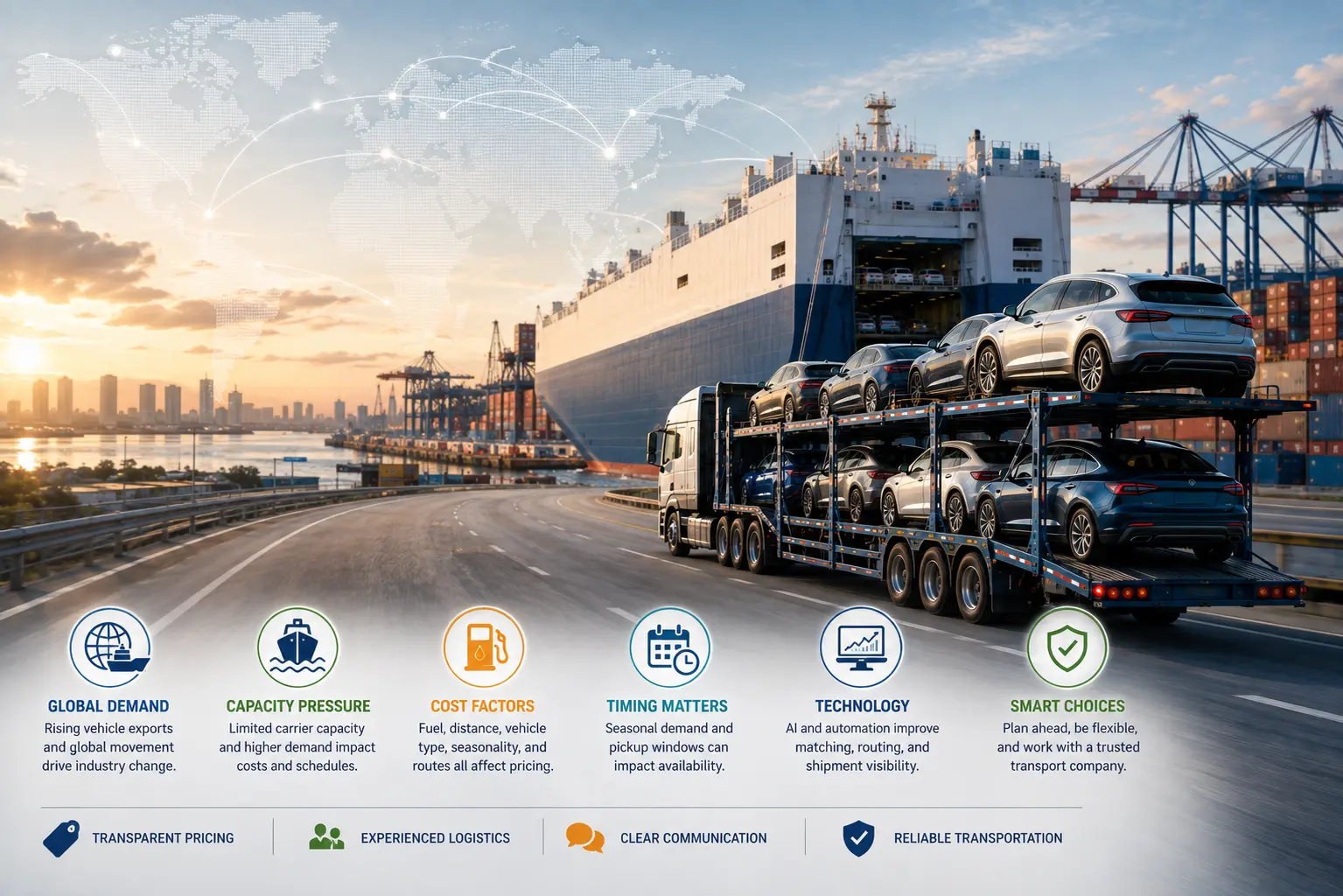
Car shipping prices don’t exist in isolation.
The cost of transporting a vehicle depends on several factors, including fuel, distance, vehicle size, seasonality, carrier availability, route demand, and transportation capacity.
In 2026, global vehicle demand is creating another factor that could influence transportation markets: the rapidly increasing movement of vehicles across international markets.
One of the most significant developments is the expansion of Chinese vehicle exports.
According to recent reporting from The Wall Street Journal, China’s vehicle exports could approach 10 million vehicles in 2026, compared with fewer than 600,000 in 2019. At the same time, global car-carrier capacity is under pressure.
So what does this mean for the broader vehicle transportation industry?
1. Global Vehicle Movement Is Increasing
Automakers increasingly operate in global markets.
Vehicles manufactured in one country may be sold thousands of miles away.
This creates demand for:
- Ocean vehicle shipping
- RoRo transportation
- Container shipping
- Ports
- Rail transportation
- Trucking
- Final-mile delivery
When vehicle volumes increase, every part of the logistics network has to handle additional demand.
2. Car Carrier Capacity Matters
One of the most important factors in vehicle transportation is available capacity.
Car carriers cannot instantly increase their capacity when demand rises.
New vessels require significant investment and time to build.
Recent reporting indicates that global vehicle-carrier capacity has expanded, but demand is still putting pressure on the available fleet. Charter rates have also increased sharply.
This illustrates a basic supply-and-demand principle:
More vehicles + limited transportation capacity = increased pressure on logistics costs and schedules.
3. Why This Matters to Customers
Consumers shipping vehicles domestically may not directly experience every global transportation change.
However, the auto industry is interconnected.
Changes in:
- Vehicle production
- Imports
- Exports
- Fuel costs
- Carrier availability
- Port activity
- Shipping demand
can eventually influence transportation costs and availability.
This is why a car shipping quote shouldn’t always be viewed as a fixed price.
Market conditions can change.
4. Timing Can Affect Car Shipping Prices
Seasonality has always been important in auto transport.
Demand can increase during certain periods because of:
- College moves
- Relocations
- Winter migrations
- Holidays
- Vehicle purchases
- Auctions
- Dealer inventory movements
When more customers need transportation at the same time, available carrier capacity can become tighter.
That can affect both pricing and scheduling.
Customers who have flexibility may benefit from discussing multiple pickup windows with their transportation provider.
5. Fuel Is Still an Important Cost Factor
Fuel remains one of the fundamental expenses in vehicle transportation.
Carriers need fuel to travel long distances, and changes in fuel costs can affect operating expenses.
But fuel isn’t the only factor.
A quote can also depend on:
- Route
- Mileage
- Vehicle dimensions
- Vehicle weight
- Pickup accessibility
- Delivery accessibility
- Carrier availability
- Seasonal demand
- Transport type
That’s why two vehicles traveling similar distances can sometimes receive different transportation quotes.
6. Why Fixed Prices Can Be Difficult
A car shipping quote represents a transportation market that can change.
If carrier availability changes after a quote is generated, the economics of the shipment may also change.
This doesn’t mean customers should accept unexplained price increases.
Instead, customers should look for transportation companies that clearly explain:
- What is included
- Whether the quote is binding or estimated
- What circumstances can change the price
- When payment is due
- What happens if pickup dates change
Transparency is one of the most important parts of a good shipping experience.
7. Technology Can Help Improve Efficiency
Technology may help transportation companies manage changing demand.
AI-powered systems can analyze routes, carrier availability, fuel costs, and other information to improve matching and scheduling.
The transportation industry is increasingly adopting automation and AI to improve network efficiency and reduce wasted capacity.
For auto transport customers, better logistics technology could eventually mean:
- Faster carrier matching
- Better scheduling
- More accurate estimates
- Improved shipment visibility
- More efficient routes
8. What Customers Can Do to Control Costs
Customers can’t control the global transportation market, but they can control several aspects of their shipment.
Book ahead
Planning early gives transportation providers more time to find an appropriate carrier.
Be flexible
Flexible pickup and delivery dates can provide additional options.
Choose open transport
Open transportation is typically the standard option and can be more economical than enclosed transportation.
Provide accurate information
Vehicle size, condition, pickup location, and delivery information can affect the quote.
Compare reputable providers
Don’t choose a company based only on the lowest price.
Check licensing, insurance, reviews, communication, and the terms of the service.
What Should Customers Expect From Car Shipping in 2026?
The vehicle transportation market is becoming increasingly dynamic.
Global vehicle production and exports are growing, transportation capacity remains an important constraint, and technology is changing how logistics companies manage shipments.
For customers, this means the cheapest quote isn’t necessarily the best option.
A reliable provider should offer a combination of:
Transparent pricing + experienced logistics + clear communication + reliable transportation.
Final Thoughts
Car shipping in 2026 is being influenced by developments far beyond the individual shipment.
Growing global vehicle exports, changing transportation capacity, fuel costs, seasonal demand, and new logistics technology are all contributing to a more dynamic industry.
Customers don’t need to understand every global shipping trend before transporting a vehicle.
But understanding the basics can help them ask better questions, plan ahead, and choose a transportation provider based on value rather than price alone.
As the transportation industry continues to evolve, companies that combine technology with experienced logistics professionals will be better positioned to deliver the predictable, transparent service customers increasingly expect.